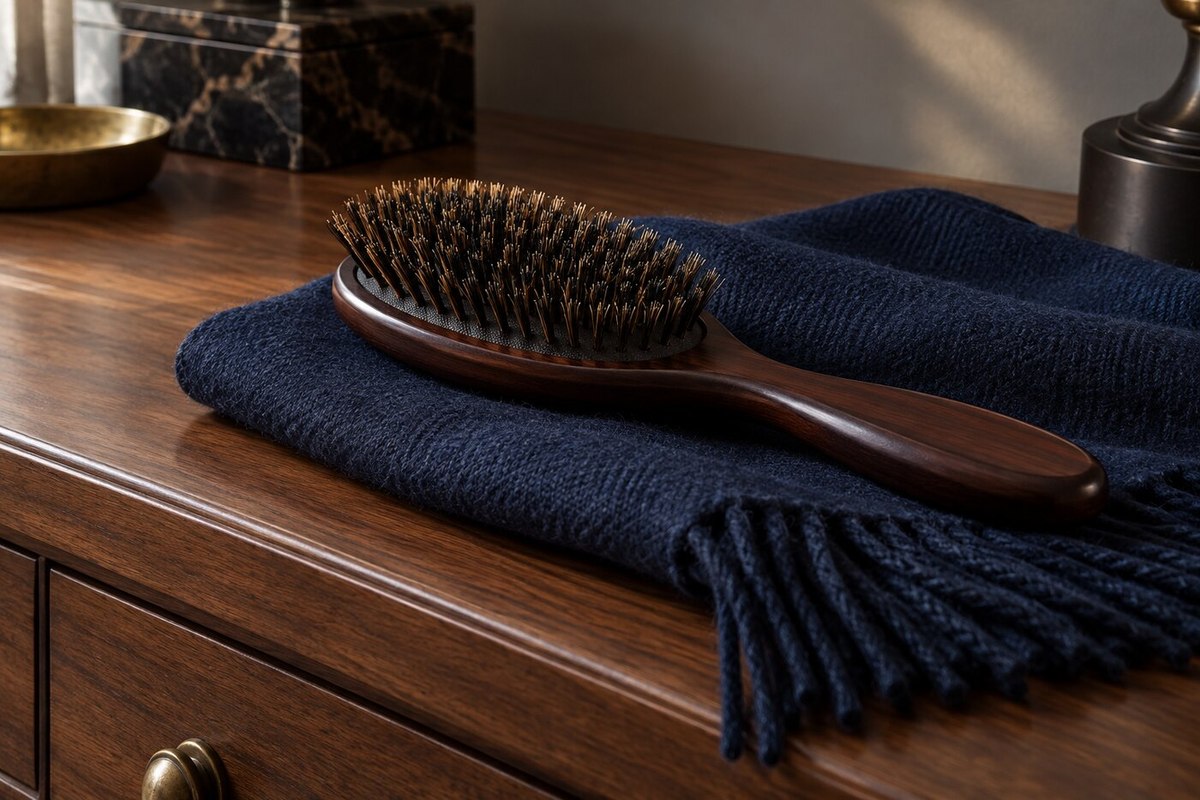
Start with our complete hair-type brush guide to match the tool to your task.
A Mason Pearson may be worth it to someone who specifically wants its construction, handling, and finishing experience. It is not a necessary purchase for healthy hair, and the price does not prove it will outperform a suitable inexpensive brush on your head. Before spending $275, identify the job you want it to do and whether that job belongs in your routine.
For a useful price comparison, we researched the Mason Pearson Junior Mixture and Sally Beauty's ion Professional Boar & Nylon Cushion Brush. Dermstore listed the Junior Mixture at $275 and marked it sold out; Sally listed the ion at $11.99 when checked October 17, 2026. This is a research-based buying analysis, not a hands-on head-to-head test or a claim that the ion is an identical replacement.
The comparison in plain numbers
| Question | Mason Pearson Junior Mixture | ion Boar & Nylon Cushion |
|---|---|---|
| Reference price | $275 at Dermstore | $11.99 at Sally Beauty |
| Broad category | Mixed boar-bristle and nylon brush | Mixed boar-bristle and nylon brush |
| What the category establishes | Materials to investigate for finishing | Materials to investigate for finishing |
| What it does not establish | Superior results for every user | Identical performance to Mason Pearson |
| Availability at research check | Listed as sold out | Listing available; verify local stock |
| Bunny hands-on comparison | Not performed for this article | Not performed for this article |
The headline rounds $11.99 to $12. The actual price difference at these references is $263.01 before tax or delivery. Those figures describe the listings, not a permanent market price or a promise of stock.
Start with the job, not the prestige
If your main problem is detangling, begin by asking whether a mixed-bristle finishing brush is the right category. Buying a luxury brush to work through a difficult knot may be an expensive way to avoid a technique question. You may need a flexible detangler, conditioning slip, smaller sections, or a comb before a finishing brush has a useful role.
If your hair is already manageable and you want a polished surface on a suitable straight or stretched style, the comparison becomes more relevant. You can then evaluate how the brush feels, how you hold it, and whether you prefer the finish. That is a specific styling decision. It does not require claiming that a premium brush repairs hair or changes the way follicles grow.
Similar materials do not mean identical tools
Two mixed-bristle brushes can differ in head shape, bristle arrangement, cushion behavior, pin length, handle, and finish. Sharing boar and nylon as broad ingredients does not settle those differences. A fair comparison would examine the exact tools and then use them under comparable conditions. Until that work is done, “same material category” is a more accurate phrase than “same brush.”
This matters in both directions. The ion's lower price does not prove it is cheaply made or uncomfortable, and the Junior's premium price does not prove a superior result for every user. Both are products with specific constructions and intended uses. Judge the actual item rather than letting either the luxury reputation or the thrill of a bargain supply missing evidence.
What Mason Pearson says about choosing a brush
Mason Pearson provides a brush-selection guide and offers different sizes and bristle combinations. That is a reason to identify the exact model before spending money. A review of a pure-boar model, a pocket model, or a different mixture cannot automatically answer whether the Junior Mixture is right for you. “Mason Pearson” names a range, not a single interchangeable tool. [Source: Mason Pearson]
Use the maker's guide as product information, then compare it with your needs. Ask whether you want the size, whether the grip seems practical, and whether the intended finish suits your hair. If you cannot identify why this particular model fits better than another category, pause the purchase. Premium shopping is easier to evaluate when you can name the feature you want.
What the affordable ion candidate offers
The ion listing identifies a boar-and-nylon construction with a rubber cushion. At $11.99, it is a relatively inexpensive way to investigate whether mixed-bristle finishing belongs in your routine. That can be a useful first step for someone who currently owns only a detangler. It should still be used on appropriately prepared hair and assessed for comfort and condition.
A lower entry price can reduce the financial risk of learning your preferences, but do not buy it merely to recreate a luxury comparison headline. If you do not want the finish, an unused $12 tool is not especially good value. If you enjoy it and it works for your task, there is no rule that you must eventually graduate to the more expensive product.
Cost per use can inform, but not justify, a purchase
At 365 uses, a $275 purchase works out to about 75 cents per use; $11.99 works out to about three cents. Spread over five years of daily use, the arithmetic becomes roughly 15 cents and less than one cent per use. These are illustrations that assume the same daily use and continued serviceability, not predictions of how long either brush will last.
Cost-per-use arithmetic can make almost any purchase look small if you extend the timeline far enough. Start by asking whether you actually want the tool and can afford it comfortably. Then consider frequency of use. Do not assume a decade of future daily brushing to rationalize a brush you have never handled, especially if your preferred hairstyle may not need that finishing step.
Durability needs evidence, not a price assumption
Long ownership stories can be interesting, but one person's experience does not establish a guaranteed lifespan. Care, storage, handling, and defects all affect an individual item. A premium brush should still be inspected for damaged pins, a compromised cushion, or rough surfaces as it ages. Keeping a tool for years is only useful while it remains appropriate and comfortable.
Before buying, read the current warranty and return terms from the actual seller. Check what is covered, what proof is needed, and whether using the product affects returns. Do not infer a lifetime replacement promise from a heritage brand image. Likewise, do not assume an inexpensive brush must be replaced on a fixed schedule if it remains intact and performs its job well.
Hair type can make the whole comparison irrelevant
Someone preserving natural curl definition may have little reason to buy either brush for dry full-length finishing. Someone with a straight style may find the category more relevant. Fine strands, high density, fragile ends, and scalp sensitivity also change handling. A general claim that a brush is for “all hair” cannot replace those decisions.
Read the complete hair-type brush guide before choosing a price tier. If you need a curl detangler, the curly-hair article is a better next step than a luxury finishing comparison. Buying the right category at a modest price is more useful than owning a celebrated brush with no clear role in your routine.
Maintenance belongs in the value calculation
A brush can feel wonderful and still be inconvenient if its care requirements do not fit your life. Read the exact cleaning directions, including limits around water, heat, and storage. Natural bristles and cushions deserve particular attention to the maker's method. Do not improvise soaking or disinfectant exposure simply because a tool seems durable or expensive.
The professional setting adds a separate question. A personal finishing brush is not automatically suitable as a shared spa tool. If the required hygiene process is incompatible with the construction, the price does not solve the mismatch. Our brush-cleaning and disinfection guide explains why personal maintenance and between-client protocols cannot be treated as the same process.
What a fair hands-on comparison would record
A useful comparison would identify both exact models, describe the hair, keep preparation consistent, and use comparable sections. It would record comfort, catches, grip, the finish the user preferred, and cleanup. It would also state which brush was used first and whether different areas of the head behaved differently. Those details help readers decide whether the experience resembles their own.
A photograph of two piles of collected hair would not establish which tool prevents hair loss. A visibly smoother section would demonstrate a styling result under those conditions, not permanent repair. A thoughtful review can still be decisive: “I prefer this handle and finish enough to pay more” is useful. It simply should not become an unsupported medical or universal performance claim.
Buying from the right seller matters
Verify the exact product name, seller, quantity, and current price. Marketplace listings and similarly named models can complicate a quick search. If authenticity is a concern, consult the manufacturer's current authorized-seller guidance rather than relying on a low price or attractive listing photos. Keep the order information and product packaging while checking the item and care directions.
The Dermstore listing used for this article was sold out at the research check. That is a price reference, not an instruction to place an unavailable item in your cart. If you choose another retailer, recheck availability and terms there. A comparison remains useful when its limits are stated; it becomes misleading when a historic or unavailable price is presented as an easy purchase today.
Decide what would change your mind
Before ordering, name the evidence you would need to feel comfortable with the price. It might be handling the exact model at an authorized retailer, understanding its care requirements, or learning that you prefer a mixed-bristle finish after trying a less expensive candidate. You might also decide the purchase is a discretionary pleasure rather than a performance upgrade. That distinction helps you evaluate it honestly. There is nothing wrong with wanting a particular beautiful tool, but its appeal does not need to be defended with claims about growth, repair, or universal superiority that the available comparison cannot establish.
Who might reasonably choose each option?
Consider the Junior Mixture if you want that specific model, understand its role and maintenance, and value the experience enough to accept the price. Consider the ion if you want an affordable mixed-bristle candidate and do not need a luxury construction to enjoy the category. Choose neither if your current tools already work or if mixed-bristle finishing is not a task you need.
Sources and price references
Reviewed October 17, 2026. Manufacturer and retailer descriptions establish product specifications and listing prices, not independent performance results.