Start with our complete hair-type brush guide to match the tool to your task.
To clean a personal hairbrush, remove trapped hair, wash the compatible parts according to the manufacturer's instructions, and let the brush dry as directed. Disinfection is a separate process that requires a suitable tool, a suitable product, and the correct label directions. Washing with shampoo does not automatically disinfect a brush, and a quick mist of disinfectant does not automatically make every brush safe to share.
The construction matters. An open plastic detangler, a wood-handled boar brush, and a cushioned brush can require different care. Start by identifying the exact tool and the setting in which you use it. This guide separates ordinary household maintenance from the more specific questions that arise for professional tools used between clients.
Cleaning methods at a glance
| Tool or setting | First decision | What to avoid assuming |
|---|---|---|
| Personal all-plastic detangler | Read its wash and drying directions | Every plastic brush is safe for any chemical |
| Natural-bristle brush | Follow the maker's method for bristles and base | Long soaking is harmless |
| Wood-handled or cushioned brush | Check limits for water, adhesives, and cushion | The entire tool can be immersed |
| Shared professional tool | Confirm cleaning and disinfection compatibility | Household washing is a between-client protocol |
| Damaged or hard-to-clean tool | Assess whether it should be retired | Stronger chemicals will fix physical damage |
Step one: identify what you actually own
Find the model name and manufacturer's care guidance before choosing a cleaning method. Look beyond the bristles: the handle, cushion, vents, glued parts, and hollow areas can affect the instructions. A tool can appear to be plastic while containing a cushion or assembly that should not be soaked. Similar shapes from the same brand may also have different care limits.
If the instructions are missing, ask the maker rather than borrowing a method from a different brush. Provide the model name and a clear description of the construction. Ask whether it can be rinsed, whether immersion is permitted, which cleaners are compatible, and how it should dry. Those questions are especially useful before buying a tool for repeated professional use.
Step two: remove trapped hair gently
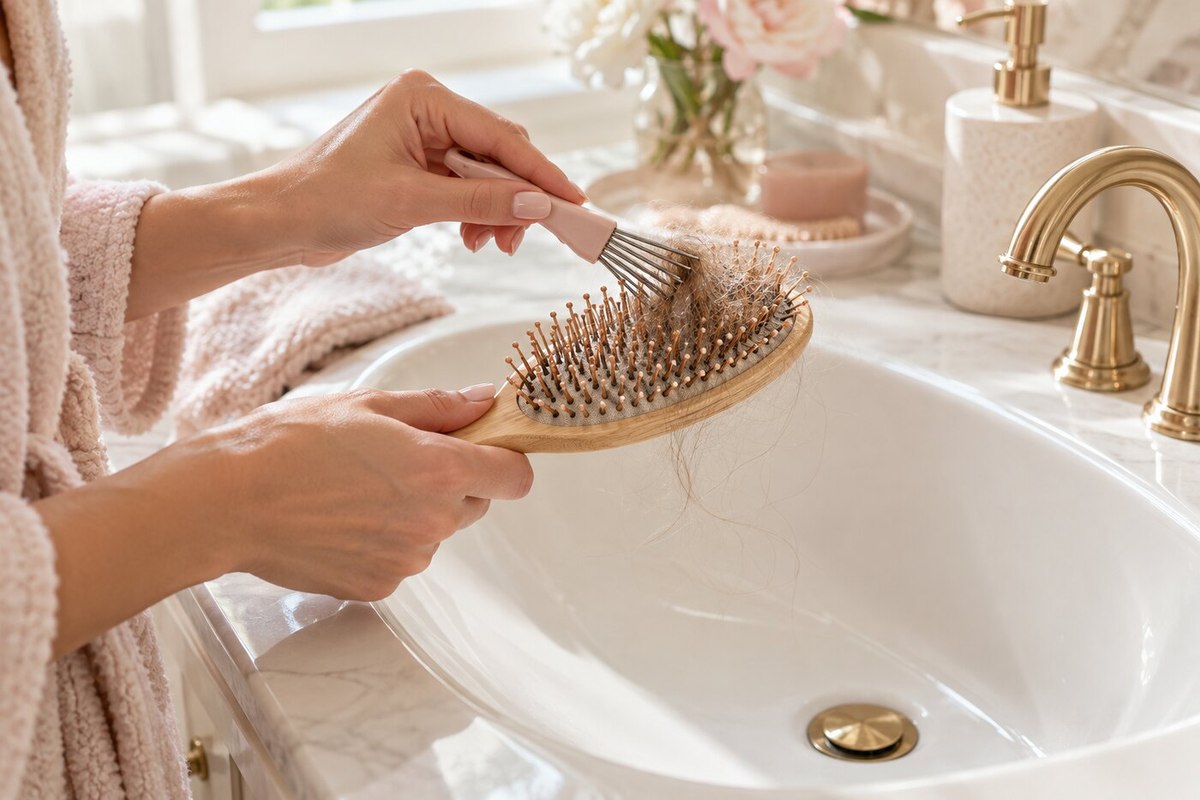
Lift out loose hair with your fingers or an appropriate cleaning tool, taking care not to bend pins or damage the cushion. Work in manageable amounts rather than yanking a tightly packed layer from one side. If the brush includes a dedicated cleaning brush, follow the manufacturer's instructions for using it. The purpose is to expose surfaces for inspection and washing.
Avoid cutting blindly toward the base with sharp scissors. You can nick a cushion, damage bristles, or injure your hand. If hair has wrapped tightly around an inaccessible area, slow down and inspect it in good light. A brush that cannot be cleared adequately may no longer be a practical tool to maintain, particularly in a setting where thorough cleaning is essential.
Step three: inspect before washing
Look for missing pin tips, bent teeth, cracks, loose components, or rough edges. Check where the bristles meet the base and whether the cushion is lifting. Cleaning can remove buildup; it cannot restore a broken pin or make a sharp crack smooth. A damaged brush should not return to your hair simply because it smells clean after washing.
Also notice whether residue is accessible. A visible film at the base may need gentle scrubbing with a compatible small cleaning brush. A sealed cavity that retains debris presents a different problem. Do not poke holes or dismantle a tool unless the maker permits it. If maintenance requires improvised repairs, consider whether replacement with a more serviceable design is the better choice.
Step four: wash only as the maker allows
Use the cleaner, water temperature, and contact method recommended for the exact brush. For some plastic detanglers, a mild soapy wash and gentle scrubbing may be appropriate. For natural bristles, wood, or cushions, the instructions may limit how much water reaches the base. More soaking time is not automatically more thorough care.
Tangle Teezer's brand response on its Target Ultimate Detangler listing describes removing hair, gently cleaning between the teeth and base with soap and warm water using a clean toothbrush, rinsing, and drying naturally with the teeth facing up. That is a model-specific example, not a universal drying rule. Follow your own brush's instructions when they differ.
Step five: rinse, dry, and store appropriately
Remove cleaning residue as directed and give the brush time to dry in the recommended position. Avoid putting a damp tool into a closed drawer or travel pouch. Do not use a hot dryer, radiator, or dishwasher as a shortcut unless that method is explicitly permitted. Heat can be a separate compatibility question from water exposure.
Once it is completely dry, store the brush where it is protected from new debris and physical damage. In a shared bathroom, keep personal tools identifiable rather than allowing several brushes to become an indistinguishable pile. If you transport a brush, make sure its cover or pouch is clean too. A washed brush placed into a dirty container is immediately exposed to the same buildup you just removed.
How often should you clean a personal brush?
Inspect it regularly and remove caught hair as part of normal maintenance. Washing frequency depends on use, styling products, the tool's instructions, and how quickly residue appears. Someone who uses heavy styling products may need a different schedule from someone who uses a brush occasionally on otherwise clean hair. A fixed internet schedule cannot account for all of those differences.
Use visible residue and the maker's guidance to plan a routine you can maintain. Cleaning before buildup becomes tightly packed is generally easier than tackling a neglected base. If the brush still feels coated after a compatible wash, do not simply increase chemical strength. Recheck the cleaning method, inspect inaccessible areas, and ask the manufacturer what it recommends for that material.
Cleaning and disinfection answer different questions
Cleaning removes hair, product, and other material from the tool. Disinfection uses a product with specific antimicrobial directions on a compatible surface. The two steps are related because visible material should be removed before disinfection. They are not interchangeable: a clean appearance does not prove disinfection, and applying disinfectant over trapped hair does not replace cleaning.
For personal household care, follow the brush maker's routine and any advice relevant to a specific contamination concern. For professional use, follow the requirements that apply to the service and location as well as the disinfectant label. Avoid calling an ordinary soapy wash “sterilization.” That word describes a different outcome and should not be used casually in a service description or product demonstration.
Professional tools need compatibility before purchase
Before selecting a shared brush, establish whether it can tolerate your required cleaning and disinfection process. Ask about the entire construction, not just the bristle material. A nonporous handle does not establish that the cushion, wood components, natural bristles, or adhesives are compatible with immersion or a particular chemical. Consumer washability is not sufficient evidence for repeated professional processing.
Follow the disinfectant's exact directions
Use a product labeled for the intended surface and purpose, at the correct dilution and contact time. The BARBICIDE concentrate label, for example, describes pre-cleaning hard, nonporous beauty and barber implements before complete immersion for the specified period. That example does not mean every product sold under a familiar brand has the same instructions, or that every hairbrush is compatible.
Read the current label on the product you actually use. Confirm the required wet contact time, preparation, solution handling, and any rinsing or drying directions. A quick spray-and-wipe demonstration should not be presented as complete disinfection unless it meets the applicable label and setting requirements. Do not create a stronger solution on the assumption that extra concentration is safer or more effective.
What to do with natural bristles and delicate construction
A personal boar-bristle brush may have a useful place in someone's finishing routine while being inconvenient for a shared professional process. Those are separate suitability decisions. Do not assume that a familiar luxury brush belongs in a spa kit because it feels pleasant or photographs well. Ask the manufacturer for explicit compatibility information before adopting any disinfection method.
If the construction cannot tolerate the process your setting requires, choose a different professional tool or an appropriate dedicated-client arrangement that meets applicable requirements. Do not invent a workaround by misting the tips and calling the whole brush disinfected. The boar-versus-nylon guide explains material choices; hygiene compatibility still needs its own evaluation.
Contamination concerns are not ordinary buildup
If there is blood, suspected infection, lice, or another specific contamination concern, pause ordinary use and follow the relevant public-health, professional, and manufacturer guidance. Keep the tool from being casually shared while determining the appropriate response. Routine cosmetic cleaning advice should not be stretched into a universal treatment for every type of contamination.
Likewise, a musty smell or persistent residue inside a tool may call for replacement rather than repeated improvised cleaning. Strong fragrances can hide an odor without solving its cause. Inspect the construction and ask whether you can actually reach and maintain the relevant surfaces. A tool should earn its continued place in your routine by being both serviceable and comfortable to use.
Make cleaning part of choosing your next brush
Before you buy, look at access to the base, the number of crevices, the drying directions, and whether replacement is reasonable if damage occurs. An open-back design may be easier for you to inspect, but it does not automatically carry a disinfection approval. The complete hair-type guide can help you choose the correct job category before comparing maintenance details.
Sources and price references
Reviewed October 17, 2026. Manufacturer and retailer descriptions establish product specifications and listing prices, not independent performance results.