Start with our complete hair-type brush guide to match the tool to your task.
There is no single wet-or-dry rule for every head of hair. Straight hair, natural curls, fragile ends, and finished styles create different handling decisions. The American Academy of Dermatology advises minimizing handling of wet hair for most people, while making an important exception for tightly curled or textured hair. That exception is why a blanket instruction to “always brush dry” can be misleading. [Source: American Academy of Dermatology]
A practical comparison
| Situation | Starting approach to consider | Important limit |
|---|---|---|
| Straight hair after washing | Reduce handling; consider a smooth wide-tooth comb and gentle technique | Wet hair still needs care |
| Natural curls or coils | Detangle with moisture, conditioning slip, and suitable tools | Avoid forcing a brush through dry curls |
| Dry, manageable straight style | Light arranging or finishing if needed | More passes are not automatically useful |
| Set waves or curls you want to preserve | Targeted handling rather than whole-head brushing | Brushing may change the finish |
| Extensions or protective styles | Follow the installer's maintenance method | Generic advice does not cover attachments |
Why the question needs context
“Wet” can mean dripping from the shower, damp after a towel, or lightly misted during a refresh. “Brushing” can mean removing a difficult knot, smoothing a ponytail, or shaping hair while drying. Those distinctions matter. A recommendation that is sensible for one of those moments can be inappropriate for another, even for the same person.
Be precise when describing a routine or reading a product review. If someone says a brush worked beautifully on wet hair, ask whether conditioner was present, how large the sections were, and whether the hair was already partly detangled. Without that context, the statement tells you a preference but gives you little information about how to reproduce the experience on your own hair.
Straight hair: avoid making wet handling automatic
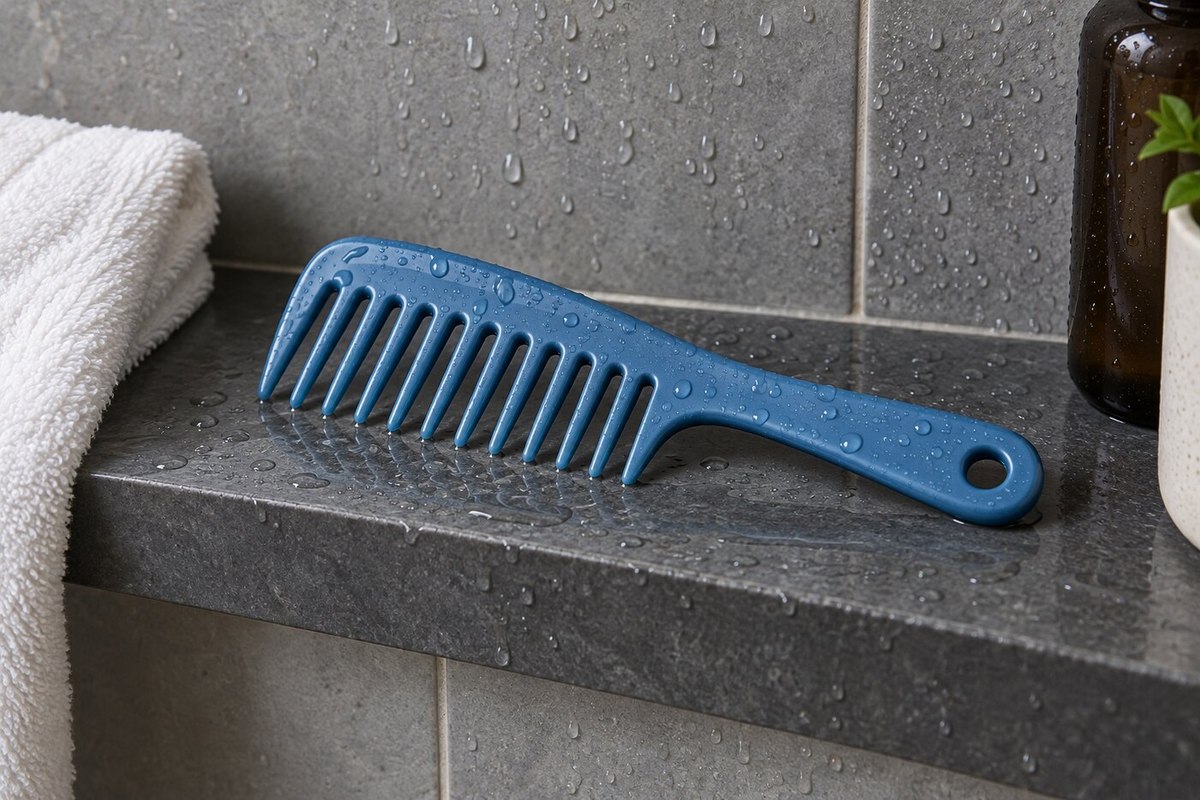
After washing straight hair, take a moment before reaching for the same brush you use on a dry style. A smooth wide-tooth comb may provide the control you need for careful detangling. Let the task determine how much handling is necessary. If your hair is already manageable, there is no reason to add repeated passes simply because washing has ended.
Work on accessible ends and support the section rather than pulling from the roots. If a comb or brush catches, pause and deal with the catch. Allowing hair to dry somewhat may suit your routine, but drying alone does not make a knot safe to force through. The method remains important regardless of the amount of water left in the hair.
Curly and coily hair: moisture changes the approach
Do not reduce this advice to “water makes every brush safe.” Preparation still includes enough slip, sensible sections, and a willingness to stop at resistance. A dense finishing brush does not become a dedicated detangler because the hair is wet. Our curly-hair guide explains which tools belong to knot removal and which belong to arranging curl clumps afterward.
Wavy hair: choose the finish before brushing
Waves can make the wet-or-dry decision feel inconsistent because the desired result may change from day to day. If you want to preserve an air-dried wave pattern, brushing a dry finished style may alter it. If you deliberately want a brushed-out finish, that change can be intentional. Decide which result you want before judging the brush by the amount of volume or frizz afterward.
For tangles, consider your wash-day preparation and use targeted handling. For a refresh, identify the area that actually needs attention instead of automatically brushing through the whole head. You may find that your fingers are enough. A purchase cannot settle a styling preference that has not yet been chosen, so describe the finish you like before shopping for a supposedly ideal “wavy hair brush.”
Fine strands and damage need a gentler decision process
Fine strands do not necessarily mean low density, and damaged hair does not have one universal pattern. You may have very dense fine hair with worn ends, or lower-density coarse hair with localized fragility. Keep those descriptions separate. Choose section size and tool flexibility around the actual section rather than assuming that a broad “fine” label answers the timing question.
If a fragile area keeps catching, do not test whether wet or dry force is more successful. Inspect the tool, add appropriate preparation, and reassess what the hair needs. A brush cannot repair split ends, and a softer brush cannot erase a chemical history. Persistent breakage or a sudden change may need a stylist's or dermatologist's assessment rather than another detangling experiment.
Read “wet and dry” as a product-use statement
A manufacturer may describe a detangler as suitable for wet and dry use. That identifies intended use conditions for the tool; it is not a recommendation to brush every texture in both states. Your curl pattern, style, condition, and task still govern the method. The broad label should be the beginning of your reading, not the end.
Also separate wet-use suitability from heat suitability. A brush that can contact damp hair is not automatically approved for direct exposure to a hot dryer. Check the exact model's instructions before combining it with heat. Brand families often include dedicated drying versions as well as ordinary detanglers, and the similar packaging does not make their limits interchangeable.
How to prepare a section without rushing
Have the tools and product you intend to use within reach. Divide the hair into manageable areas, then start where the tangle is accessible rather than beginning with a full root-to-end stroke. Hold the section so that a catch does not automatically pull at the scalp. Give yourself permission to switch to fingers when you need more precise control.
If the method suddenly feels difficult, reassess before continuing. Has the section dried during a curly routine? Are you working with too much hair at once? Is the tool damaged or clogged? Those are useful questions because each suggests a concrete adjustment. Pulling more firmly hides the reason for the resistance and can turn a simple grooming task into an uncomfortable one.
Detangling, drying, and finishing are separate stages
You can use different tools for different stages without making the routine complicated. A comb or detangler can address knots, a heat-rated styling brush can help shape a blowout, and a finishing brush can arrange an appropriate dry style. You may need only one of these stages. The point is to avoid demanding that one tool perform every job equally well.
When buying, identify the stage that currently causes frustration. If your blowout lacks the shape you want, a third detangler may not help. If knots are the issue, a luxury finishing brush may be the wrong category. Our complete hair-type guide connects those tasks to tool categories so you can shop with a more specific purpose.
Extensions, wigs, and protective styles need their own instructions
Follow the maintenance guidance for the exact style or attachment system. Water, product, brushing direction, and support around bonds or tracks may all require specific choices. A generic article cannot establish what an installer recommends for your hair. Before changing the routine, ask which areas can be brushed and how the hair should be held.
Locs and other intentional structures are not ordinary tangles waiting for a brush. Treating them that way misses the goal entirely. The same is true of a carefully set style you want to keep. A useful routine preserves what you intend to preserve, and it is reasonable for the right decision to be avoiding a brush in a particular area or at a particular time.
Why dry appointments need a separate conversation
Clean tools matter in either condition
Remove caught hair and follow the maker's cleaning directions. A wet-use brush still needs to dry appropriately before storage; a dry-use brush still accumulates residue. Inspect teeth, bristles, and the base so a damaged area does not become a repeated source of catching. Our cleaning guide covers the differences between a personal wash and professional disinfection.
If you compare brushes, keep the condition of the tools comparable as well. A clean new detangler beside a clogged old brush is not a fair test of their original designs. Record what changed and describe what you observed. You can make useful personal choices without turning an informal bathroom comparison into a universal verdict about which brand causes less damage.
Frequently asked questions
Is damp hair always the safest compromise?
No. “Damp” does not settle the texture, product, or task questions. Your routine may call for thoroughly prepared curls, minimal handling of straight hair after washing, or light finishing on a dry style. Choose the method that fits the situation instead of treating the halfway point as automatically safest.
Should I switch brushes if my current routine hurts?
Stop the painful movement first. Check the section, preparation, and tool condition before buying a replacement. A different brush might help, but continued pain is not a normal test you need to complete. Persistent scalp discomfort deserves attention beyond a shopping decision.
Can one brush handle both conditions?
Possibly, if the maker allows it and the design suits your tasks. You can compare specific flexible detanglers in our Wet Brush, Tangle Teezer, and Unbrush guide. The most useful choice is the one you can use appropriately, maintain easily, and stop using when the job is finished.
Sources and price references
Reviewed October 17, 2026. Manufacturer and retailer descriptions establish product specifications and listing prices, not independent performance results.