Start with our complete hair-type brush guide to match the tool to your task.
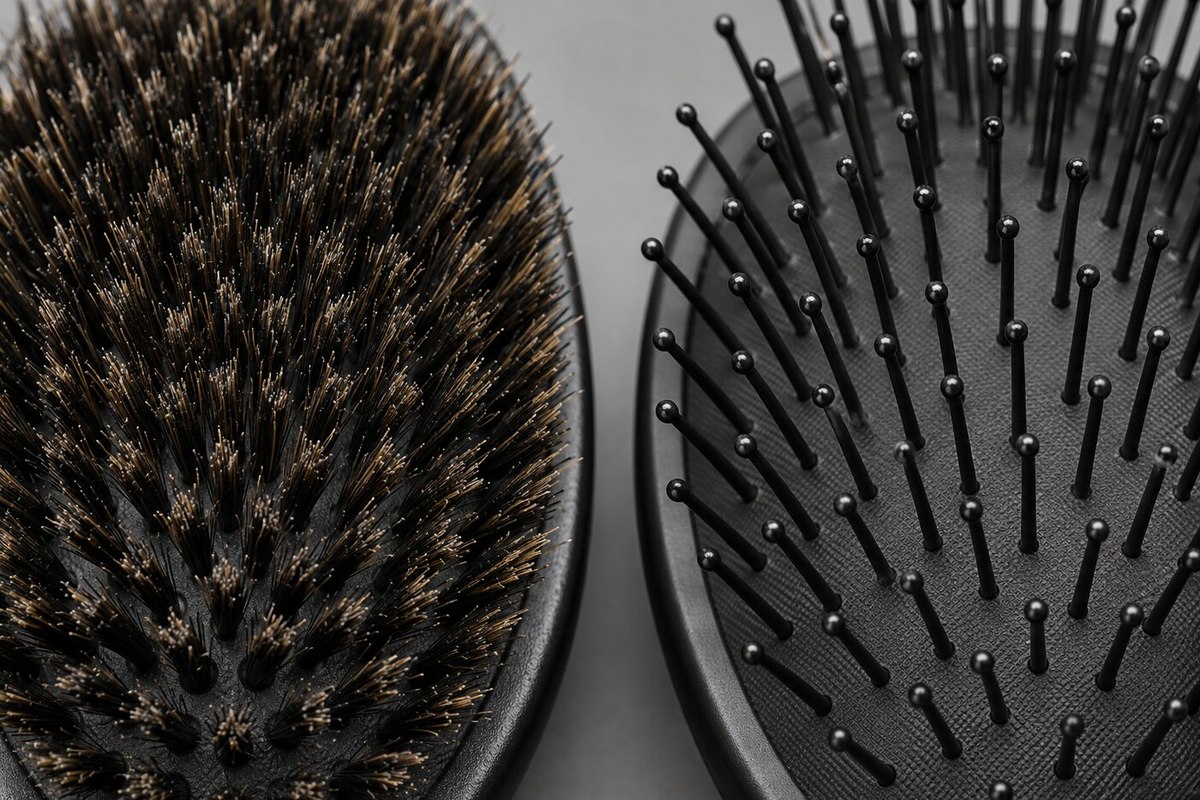
Choose between boar bristle and nylon by the job you want the brush to do. Boar-bristle brushes are commonly considered for finishing suitable dry hair, while nylon appears in everything from flexible detanglers to firmer styling tools. A mixed brush combines the materials in one head. None of those labels, by itself, tells you that a brush is right for your texture, style, or maintenance routine.
The useful comparison goes beyond “natural versus synthetic.” Look at bristle length, spacing, flexibility, cushion, tip finish, and the condition of your hair. A soft, dense finishing brush can feel very different from a nylon detangler even when both have oval heads. This guide helps you choose the category first and evaluate the individual brush second.
Materials and jobs at a glance
| Construction | Consider it for | Check before buying |
|---|---|---|
| Boar bristle | Finishing detangled straight or suitable stretched hair | Bristle density, feel, and cleaning instructions |
| Flexible nylon or plastic detangler | Releasing tangles using an appropriate method | Flexibility, smoothness, and section control |
| Longer nylon pins | Reaching into manageable sections | Pin condition and pressure needed |
| Boar-and-nylon mixture | Combining reach with surface finishing | Whether the combination suits your actual task |
| Synthetic finishing brush | An animal-free finishing preference | Exact material and construction claims |
Material is only one part of the design
Imagine two nylon brushes: one has widely spaced flexible bristles and another has tightly packed, firmer pins. They share a material label but can behave differently in your hand. The same is true of natural-bristle tools. Density, trim, and construction change how the brush meets your hair. Shopping only by the word on the front of the package skips those distinctions.
Begin by handling the brush as its packaging permits and reading the full description. Ask whether you want reach, flexibility, surface control, or a particular grip. Those are observable features. Claims about “healthy hair” or “salon quality” are much harder to interpret without details. A material can be part of a useful design without becoming a guarantee of the result.
When to consider boar bristle
Boar-bristle brushes are often chosen for polishing a style after tangles have been addressed. If you wear straight hair or an intentionally stretched finish and want a more arranged surface, that is a relevant job to investigate. It is different from asking a dense brush to work through a knot. A finishing pass should not become an excuse to force the brush through resistance.
Decide whether you like the look the tool is meant to create. You may prefer a softer, less arranged finish, in which case a dense polishing brush may be unnecessary. Someone else may want a smooth ponytail and find a finishing brush useful. Neither preference establishes that all hair needs natural bristle. The purchase makes sense only if the intended result belongs in your routine.
When nylon is the more relevant category
Nylon is used in a wide range of brushes, including detangling and styling designs. If knots are your main concern, investigate flexible detanglers rather than assuming every nylon brush will work the same way. Compare the spacing and movement of the bristles, the size of the head, and how easy the brush is to control in a small section.
If you have dense hair, longer pins may be worth considering, but sectioning remains important. You should not have to press a brush hard against the scalp to make it reach. If you have fine strands, a softer design may feel more controllable. These are starting points for choosing, not universal rules that can be settled by the thickness of your ponytail alone.
What a mixed-bristle brush changes
A mixed brush places boar bristles and nylon pins together. The nylon may extend farther than the natural bristle, depending on the model, creating a different arrangement from a pure boar brush. That construction is a reason to compare the design closely. It does not mean every mixed brush is interchangeable or that the least expensive one duplicates a premium product.
Look at the length difference, the density of the tufts, and the cushion. Think about whether you want a finishing brush that reaches farther into a prepared section. If you already have an effective detangler, the mixed brush should add a separate useful result. Buying it as a more impressive version of a detangler may lead to disappointment if finishing is its better role.
Fine hair needs more than a soft label
Fine describes individual strands, not the amount of hair on the scalp. A person with fine, dense hair may need smaller sections to get a consistent result. Someone with fine, lower-density hair may prefer a different head size and a lighter feel. Do not translate “fine hair” automatically into one large pure-boar paddle or one particular stiffness.
Notice how the brush behaves without increasing pressure to make it perform. If it skims the surface, reduce the section or reconsider the design. If it catches, stop and identify the reason. Softness can be appealing, but a brush still needs to accomplish an appropriate task. A tool that feels pleasant in your hand may be better for one kind of finishing than another.
Curly and coily hair requires a styling decision
If you want to preserve natural curl definition, a dense finishing brush may produce a change you do not want. Do not treat surface smoothness as the default goal for every texture. A curl detangler used within a conditioned routine and a brush used on an intentionally stretched style are serving different purposes. Your choice should follow the style you want to maintain.
Read our curly-hair brush guide before choosing a finishing brush for natural curls. It explains the difference between detangling and defining. A product can be suitable for one stage of a curly routine while being unsuitable for another. The material label cannot tell you when to use it, how much slip you need, or whether your finished style should be brushed at all.
Damaged ends, gray hair, and changing texture
A new life stage or hair color does not create a single brush prescription. Instead, describe what is changing: increased tangling, rough-feeling ends, scalp sensitivity, or a finish that is harder to arrange. Match the tool and technique to that observation. Someone with gray straight hair and someone with gray coils may need very different routines even if they shop the same “mature hair” aisle.
Neither natural nor synthetic bristles repair split ends. If a worn area repeatedly catches, a softer brush may change the handling experience without solving the underlying issue. Inspect the tool for defects and consider the condition of the hair separately. An expensive finishing brush should not be used to postpone a needed care decision merely because its marketing describes restoration or rejuvenation.
Cleaning may decide the purchase
Natural bristles, cushions, wood handles, and adhesives can come with specific washing limits. Read the maker's instructions before assuming a brush can soak in water. A tool that is easy to rinse at the tips may still trap moisture or residue near the base. The right cleaning method depends on the whole construction, not just whether the visible bristles are natural or synthetic.
For professional use, the question becomes more specific: can the exact tool tolerate the cleaning and disinfection process required in that setting? Do not assume a nylon label answers yes or that a spray makes any natural-bristle brush suitable between clients. Our cleaning and disinfection guide explains why personal ownership and shared service tools need separate decisions.
Animal-free preferences deserve a precise label
If you want to avoid animal-derived materials, pure boar bristle and boar-and-nylon mixtures do not meet that preference. Look for a clearly identified synthetic construction and ask the manufacturer if the listing is ambiguous. A wood handle or green-looking package does not establish what the bristles contain. “Natural” also does not mean an item is automatically better for your hair.
If environmental claims matter to you, separate them from the styling comparison. A plant-based handle, recycled component, and animal-free bristle claim describe different things. Ask which component the claim applies to and how the tool should be disposed of. You can make a values-based purchase without allowing broad packaging language to stand in for information about the brush itself.
Compare $11.99 with $275 honestly
Sally Beauty listed the ion Professional Boar & Nylon Cushion Brush at $11.99 during our October 17, 2026 research. Dermstore listed the Mason Pearson Junior Mixture at $275 and marked it sold out. Both use a mixed-bristle category, but that fact alone cannot establish equal comfort, finish, durability, or construction. Calling one a “dupe” needs more evidence than matching material names.
Our Mason Pearson article looks at that price comparison in detail. You can consider the ion as an affordable finishing candidate and still recognize that the two products have not been tested head-to-head here. You can also decide the premium construction appeals to you without claiming it is necessary. Price and material are useful facts, not a performance verdict.
Try a modest, controlled routine
Begin with hair that is appropriately detangled for your texture and intended finish. Use a small enough section to understand how the brush behaves. Make a light pass, notice the result, and decide whether another pass has a purpose. If the tool catches, return to detangling rather than using the finishing brush more forcefully. Stop when the desired arrangement is achieved.
Keep notes if you are comparing brushes: model, section, hair state, products, comfort, and the finish you actually prefer. Do not compare a freshly conditioned section with a dry, tangled one and credit the difference entirely to bristles. The complete hair-type guide can help you describe the variables that matter before you decide which material suits you.
Where a pleasant brushing experience fits
Choose the category around your goal, inspect the exact tool, and account for cleaning. If your detangler already works well and you do not want a different finish, there may be nothing else to buy. If you do want a polishing step, consider an appropriate finishing brush with clear expectations. The right material is the one that fits a useful design for your actual routine.
Sources and price references
Reviewed October 17, 2026. Manufacturer and retailer descriptions establish product specifications and listing prices, not independent performance results.